Can You React to a Hook? How to Dodge Hooks in League
League's best-known hook gives you about 0.6 s of flight at full range. When that's enough to react, when it isn't, and why turning back beats stopping.
 Piotr Vassev··4 min read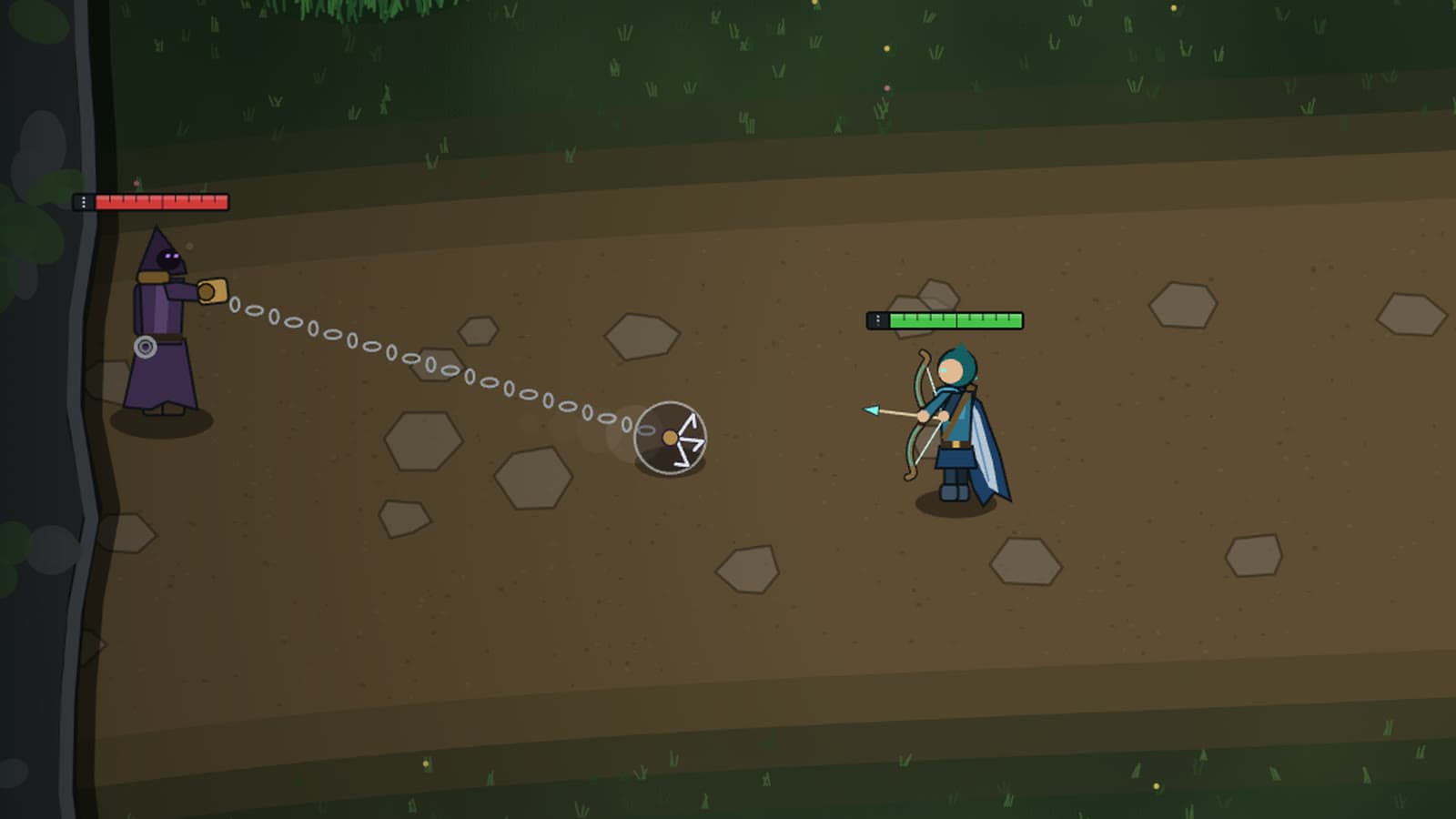
You can react to a hook at long range. Up close, you can't, and the dodge has to start before the hook is thrown. Where that line falls depends on flight time, how far you need to walk, and whether the thrower aimed at you or ahead of you.
How long a hook is in the air
Flight time is distance divided by speed. League's best-known hook, per the League of Legends wiki, has a 0.25 s cast time, a missile speed of 1,800 units/s and a range of about 1,100 units. The harpooner in our Hook Dodge benchmark is a little slower, but it throws from a similar distance.
| Range | Speed | Wind-up | Flight at max range | |
|---|---|---|---|---|
| A typical League hook | about 1,100 | 1,800 units/s | 0.25 s | ~610 ms (1,100 ÷ 1,800) |
| Hook Dodge harpooner | 700–1,100 | 1,600 units/s | 0.15 s | ~690 ms (1,100 ÷ 1,600) |
The wind-up matters. If you start reacting when the cast begins rather than when the hook leaves, you get those 250 ms on top of the flight. In our game the wind-up is deliberately 150 ms, which is shorter than any human reaction, so the clock starts when the hook appears.
The dodge budget
To dodge, you need reaction + system delay + time to walk clear ≤ flight time. These are our game's numbers:
- Walk clear: a hit is any moment the centers are closer than 61 units (hook radius 26 plus your hitbox of 35). At 350 units/s, moving 61 units takes ~175 ms (61 ÷ 350), assuming the hook is aimed at your center and you move perfectly sideways.
- Reaction + system: about 250 ms of reaction and 30 ms of display and input delay, the same assumptions as in our Flash the Engage breakdown.
That totals about 455 ms. Compare it with the flight time at each range:
| Thrown from | Flight (÷ 1,600) | Margin after 455 ms |
|---|---|---|
| 700 units | ~440 ms | about −20 ms |
| 900 units | ~560 ms | about +110 ms |
| 1,100 units | ~690 ms | about +230 ms |
At long range you have time to spare. At the shortest range, even a clean, perfectly aimed reaction ends with the hook catching your edge. That's the honest answer to "can you react to a hook": at range, yes; up close, no.
Hooks are thrown at where you'll be
The 175 ms figure assumes the hook is aimed at your center. A good hook isn't. Our harpooner only throws once you've been walking for at least 250 ms (or after you've stood still for 3 seconds), and it leads you: it aims 85–100% of the way to where your current heading takes you by the time the hook arrives.
That changes which reaction works. Say you're walking across the throw at 350 units/s and react 280 ms after release:
- At 700 units, the aim point is roughly 130–155 units ahead of where you were. Stopping leaves you about 35–55 units from the hook's line, so you're hit. Reversing puts you about 90–115 units away, a clean dodge.
- At 1,100 units the hook is aimed about 210–245 units ahead, so even stopping leaves you over 100 units clear.
Reversing works because the aim point is ahead of you: walking back moves you away from it twice as fast as stopping does. These figures are rough, since the ±12-unit jitter in the launch point and the exact throw angle shift them a little, but the pattern holds. Against a leading hook, turn back, don't just stop.
Keep walking the same way and you walk right into it. That's exactly what the lead is for.
Dodging before the throw
At close range, reaction alone can't cover the gap, so the work happens earlier:
- Spacing. Every 100 units of extra distance adds about 55 ms of flight against a 1,800 units/s hook (100 ÷ 1,800). Standing at the edge of the hook's range is the cheapest dodge there is.
- Juking. Our harpooner counts your direction changes (turns of 25° or more, or stops) over the last 1.2 seconds. With three of them it stops leading and aims at the middle of your last half-second of movement instead. Reaction Time vs Prediction in League covers how that read works and how to beat it.
- Minions. Hooks like this catch the first enemy they hit, so one of your own minions standing in the line takes the hook instead of you.
What the benchmark measures
Your reaction is the first click after the hook appears that really changes your movement: starting from a standstill, a 25° or bigger turn, or a stop. Clicking the same direction again doesn't count, and a click within 100 ms of the hook appearing is treated as a guess. You can still move at any time, though. Being hooked is the only real failure.
The results show your median reaction, how many hooks you dodged, your closest dodge, a direction score (1 means you moved perpendicular to the hook's path) and time to spare: how far ahead of the hook you were, in milliseconds, when you reacted.
Try it · free, in your browserHook DodgeA harpooner reads your movement and throws where you’ll be.Bottom line
A hook at long range gives you enough time for a normal reaction and a short walk. At the shortest ranges it doesn't, so you have to be dodging already. When you do react to a leading hook, reverse instead of stopping, and stay far enough away that reacting is still possible.
FAQ
- How long does a hook take to reach you in League?
- League's best-known hook has a 0.25 s cast time and a missile speed of 1,800 units per second, with a range of about 1,100 units. At full range the missile flies for roughly 600–620 ms, and it gets there sooner the closer you stand.
- Can you react to a hook, or do you have to predict it?
- At long range you can react: the flight time covers a normal reaction plus the steps needed to clear the hook. At short range the flight is shorter than reaction plus walking time, so the dodge has to start before the throw, through spacing and unpredictable movement.
- Should I stop or turn around when a hook is thrown at me?
- If the thrower led you, turn back. A leading hook is aimed ahead of you, so reversing moves you away from the aim point twice as fast as stopping. In our Hook Dodge numbers, stopping fails at the shortest range and reversing clears it.

Piotr Vassev
Software engineer, long-time League player and creator of mechanix.gg. Builds the frame-accurate timing and game simulations behind the benchmarks, and writes about what the numbers actually say.
Connect on LinkedInKeep reading